Saturday, 20 June 2015

Go with the flow - follow the bisse...


Vercorin Bisse
Within the Valais there are over 2000km of 'Bisse' - as they're called in French, and Wasserleite or Suonen in German. These ancient, man-made water channels, traverse the mountains, bringing valuable water from rivers to villages and fields. Once they were a life-line, but after WWII many fell into disuse and disrepair as technology advanced, and the cost of maintaining them rose.
Paddles and locks control the flow of the water along the Vercorin Bisse
Today, many have been restored and you can walk the well graded paths next to the channels. Here, in the Val d'Anniviers, there are several dotted around (although not all have water). Vercorin is a favourite - through forest, and around the hill into the Vallon de Réchy. It's a great walk, and on a hot day the water acts as a natural air-conditioner below the trees. Elsewhere in the Valais, there are more 'sporting' routes, such as the Torrent-Neuf above Savièse. A great example of the risks and feats of engineering that were achieved to get water to where it was needed.
Torrent-Neuf, Saviese
The Torrent-Neuf dates back to 1430, with many extension and even tunnels added over the centuries. It has recently been restored and is open to walkers between May and November. But you need a good head for heights -  bouncy new suspension bridges, link cantilevered sections of boardwalks across the tall cliff face. An amazing route, and the information panels with old photos show just how dangerous this was to build and maintain: www.torrent-neuf.com

For more hiking routes that follow bisse in the Valais:
www.valais.ch/en/activities/hiking/bisses
www.valrando.ch/bisses1/propositionsbisse.php

The Museum of bisses is in Anzère:
www.musee-des-bisses.ch/musee-bisses

Some wonderful old footage of a 'guardian' of the bisse at work:
www.rts.ch/archives/tv/information/3441605-le-gardien-du-bisse.html

Tuesday, 9 June 2015

White Russian

This year our end of season ski tour took us away from the Alps to the Caucasus Mountains, Russia. A very different adventure, and the chance to climb the highest mountain in Europe - Mt Elbrus 5642m.  Thanks Olly and Mountain Tracks for putting together a wonderful trip with great people.

Here's a 3 minute slide show (best viewed on YouTube) of the trip and a few stills to give you a taste...


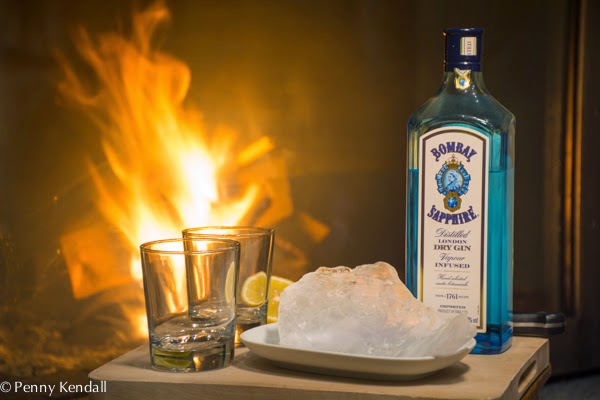
Brown and white, mixed with ice - the perfect White Russian

Fresh snow around the Ullu Tau Lodge
Flying from London via Moscow we ended up at the Ullu Tau Lodge in the Adyr-Su Valley close to the Georgian border. So close in fact that each morning required a 45minute stop at the army checkpoint to go through papers. Time to look up at the mountains and our day ahead.

The mountains around the valley
A wonderful place to ski tour and acclimatise...

Wonderful touring
before heading over to Elbrus and its infamous accommodation - 'the barrels'...

Elbrus and it's views
after 2 days of storms and some more altitude acclimatisation, we got lucky with the weather and all made it to the top (along with 100's who were competing in the 'Red Fox Race')...

A successful summit after 2 days of storm
before returning to the valley and the villages.

Some local characters

Sunday, 19 April 2015

Rule Britannia

The Britannia Hutte at 3030m
Paid for by the British members of the Swiss Alpine Club, the Britannia Hutte first opened in 1912, and was given to the SAC in thanks for the hospitality British mountaineers had always received. One hundred years on and the connection is still strong. For the centenary anniversary the British members bought the hut seven new solar panels.
Starting out to summit the Strahlhorn 4190m
Today the Britannia Hutte isn't just popular with the British in fact its the most popular hut run by the SAC in the alps. Why? As they say it's location, location, location. So close to Saas Fee (in winter ski tourers can use the lifts almost to the door - it's just a 15 minute slide and walk from the top of the Egginerjoch drag lift), and it's so close to some stunning mountains. From the hut you can summit the Strahlhorn 4190m, Fuchthorn 3795m, Rimpfischhorn 4198m, Alphubel 4206m,  Allainhorn 4027m and join the Haute-Route ski tour. And don't forget those amazing sunsets.
Stunning sunsets
But the accommodation and food is also top notch. Having undergone an extension and renovations in 1997, it can comfortably sleep 134, has 3 dining rooms, indoor loos and running water and is run by a small, extremely cheery team who work from before 5 am to gone 10pm each day. It's popularity with guides may be down to the free pre-dinner glass of wine.

One of the three dining rooms


The hut is open for ski tourers from March-May, and for summer mountaineering and climbing from middle of June to end of September. To book visit the website www.britannia.ch


Tuesday, 31 March 2015

The 'just so valley' - the Vallon de Rechy

Just so...
Why call it the 'just so valley'? Well it's just so - consistently amazing, beautiful, untracked, quiet, remote, varied, huge and long... as is the list of words which describes how much I love this valley. Throughout winter we've had some amazing journeys, whichever route we've taken, and there are lots.

Here's a small collection of images from this and previous years ski days. It's not bad in summer either...
Great skiing
Wonderful views

Magical, even on a grey day

Makes a great day tour

For more images see our FaceBook page - here are a few links to some of our Vallon de Rechy days

www.facebook.com/media/set/?set=a.1045216575493610.1073741881.232723673409575&type=3

https://www.facebook.com/media/set/?set=a.1038136209534980.1073741880.232723673409575&type=3

https://www.facebook.com/media/set/?set=a.822418427773427.1073741862.232723673409575&type=3

https://www.facebook.com/media/set/?set=a.622151517800120.1073741826.232723673409575&type=3

https://www.facebook.com/media/set/?set=a.587871347894804.147912.232723673409575&type=3

Thursday, 19 February 2015

Below 30 degrees

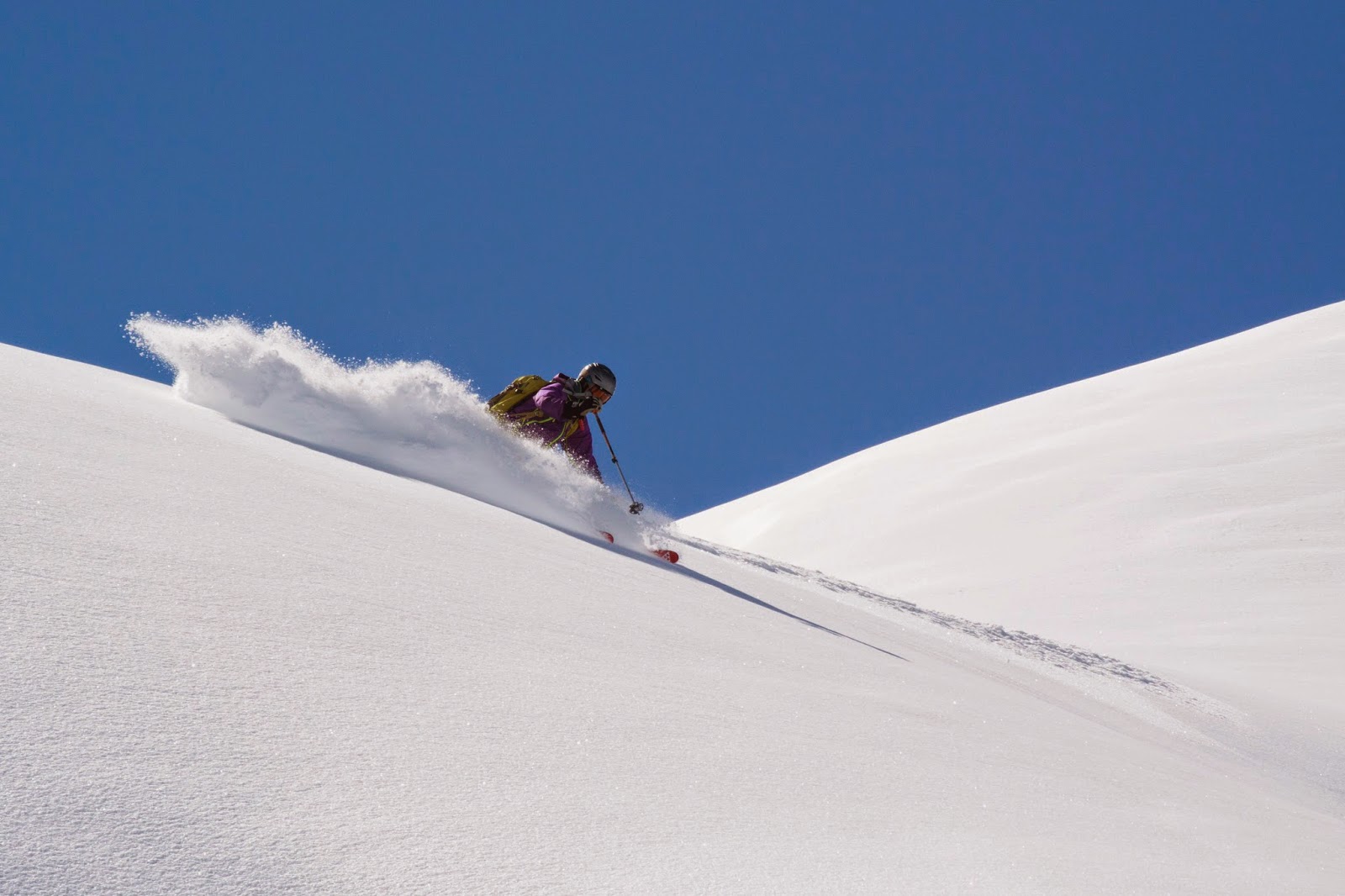
Skiing powder on low angle slopes
Below 30 sounds parky but in fact I'm thinking slope angle. This season there's already been an extraordinarily high number of skiers killed by avalanches. Many could have been avoided with better awareness and education in what causes slopes to slide.

One rule that's easy to follow is to keep to gentle terrain. Slopes less than 30 degrees in angle are generally unlikely to slide. But remember, look at what's above you too, even if your on the gentle stuff vibrations can ripple through the pack and break those weak layers in the steeper terrain above causing it to slide.

So how to tell the slope angle:

Topographical maps with winter routes,  have terrain over 30 degrees shaded in pink. For Switzerland there's an excellent range of 1: 50 000 produced and available from www.swisstopo.ch

Pink shaded steep slopes on the swisstopo maps

You can go online to use the excellent interactive mapping site with more detailed shading
www.map.geo.admin.ch

You can also attach an inclinometer to your ski pole. Then you simply lay your pole on the ground and see what angle it says. There are also poles with it already built in - K2 have an adjustable carbon pole - (LockJaw £95) unfortunately it measures from 30 - 50 degrees so if you can see the bubble your on the wrong slope...

Built in inclinometer on the K2 LockJaw ski pole

Monday, 26 January 2015

Giant ice maker - Zinal Glacier

The perfect G n T made with glacial ice and a slice
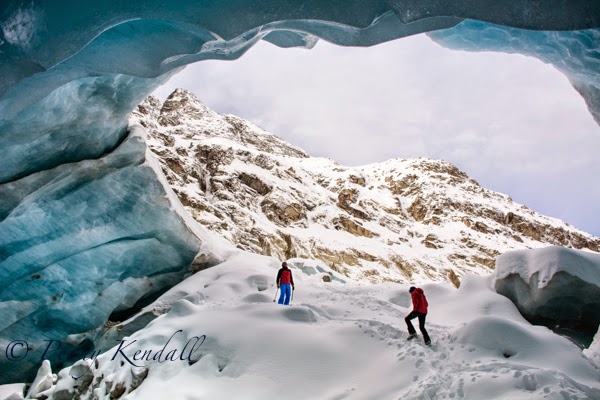
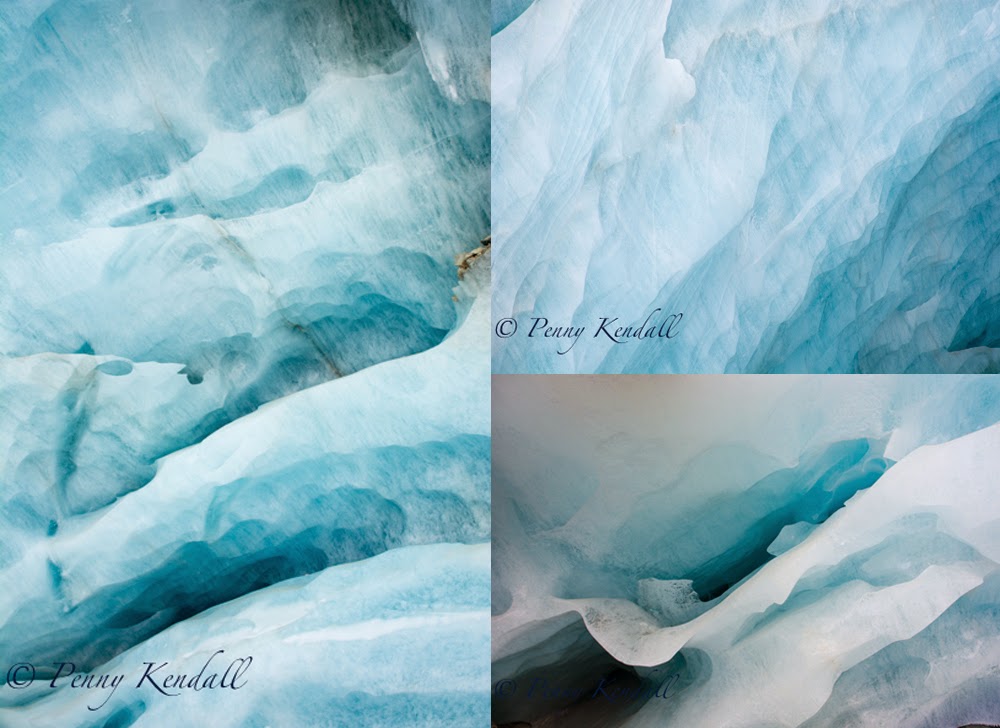
How far will you go to put some ice in your drink? Well the other day we headed off to search for the most perfect lump of frozen water we could find -  layers of snow, crushed over hundreds of years into a beautifully clear lump of turquoise ice. This natural ice maker was the snout of the Zinal Glacier.

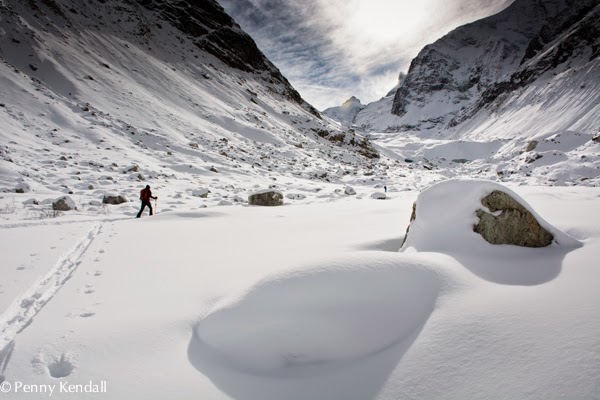
A 5km walk from Zinal following the Navisence towards the Pointe de Zinal 
The ice caves at the snout of the Zinal Glacier
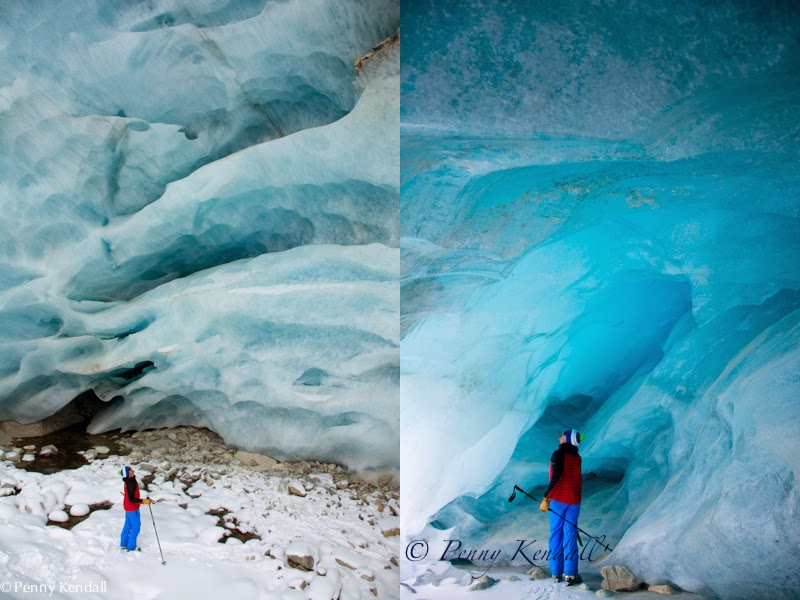
Inside the ice caves
Five icy masses - the Glacier du Cornier, Bouquetins, Durand, L'Obergabelorn and Mountet - creep down from the head of the valley and merge together to become the Zinal glacier. From the village, it's a 5 km walk south, following the Navisence river to its source - the turquoise blue ice caves at the snout of the glacier. These days it's 1.7 km further than it was 120 years ago, but the extra walk is definitely worth it.
Fifty shades of blue
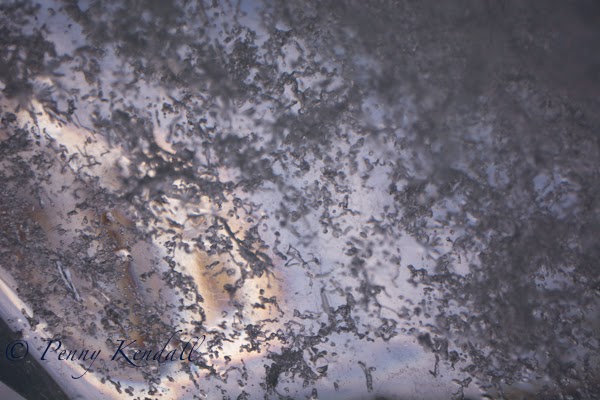
The most perfect lump of ice

Wednesday, 10 December 2014

Snow - making it happen

Snow making 

After an unusually wet summer, autumn was long, warm and relatively dry. Finally, temperatures have dropped and winter is creeping in, but the 'good' weather has continued, so not much snow. But at least it can now be made, which is exactly what's been happening.

For the last week or two all across the alps and around this valley, snow cannons have been drawing thousands of k-joules of electricity to pump and mix water with air, atomising the water into droplets which, when jetted into the freezing air form ice crystals. Over the years snow making techniques have improved so it's now less icy and comes pretty close to feeling like the real thing.

But it comes at a price:
To cover 100m x 100m's to a depth of 30 cm you need 3000m3 of snow, made from 1.3 million litres of water.
The estimated cost for 1m3 of snow is about £5 (chf 7.50) so the above 10,000m sq would cost about£15,000 (chf 22,000).

To put this into a context, a piste 60m wide and 800m long will cost around  £72,000 (chf 105,600) - that's a lot of ski passes and all you've got is a pile of snow. You then need piste machines to spread it around and the lifts to get people up the mountain....

And of course there's the cost to the environment - the extra energy used, water drained from reservoirs and other water sources and the extra water when it melts - which isn't just when spring arrives. The snow they made in November all melted on the lower slopes because it was so warm, but higher up the snow making is putting down a good base so for the Christmas guests things are looking 'al-white'.


Figures are based on information in the following articles:
www.theguardian.com/science/2014/nov/07/snow-climate-change-effect-on-skiing
www.mtbuller.com.au/Winter/Snow-Report/Snow-Making
www.adventure.howstuffworks.com/outdoor-activities/snow-sports/snow-maker.htm