Monday, 25 November 2013

Paws for thought...

Chamois tracks
Go for a walk in the snowy woods and you'll see tracks of the animals you know live there but rarely meet. You can see where they've scampered up a bank, walked around in circles following good smells, and scraped away the snow to uncover something to eat.
Squirrel, lynx, deer, & chamois prints
With freezing temperatures and snow covering the vegetation for the next 5 months or so it's a tough time for these animals. Conserving energy is the name of the game and for this reason resorts restrict areas of the mountain as no go zones for walking, snow-shoeing and skiing.
Foot-print chart from www.mountainwilderness.ch
Whilst not wanting to scare any of these beasts into having to run and use energy, you'll often see animal tracks overlying old ski tracks. Using the route where the snow is firmest they use less energy, so we believe both can co-exist in the same spaces. These animals become habituated to man and that we (in winter) are not a threat. With no natural predators the larger animals are culled each September by hunters ie the winter doesn't threaten their numbers. Unlike the hunters, who take only the beautiful and strong, nature takes the weak and those less likely to survive.

For more information on how animals behave visit www.mountainwilderness.ch.

Since writing this the canton of Valais have introduced 142 no go (to people) zones. These zones have been designed by hunters! (hum...) Some of the best and most easily accessed off-piste terrain is affected by this ruling, areas close to the resorts. You can find out more about where they are on the following website -  www.respecter-cest-proteger.ch  - closest to here is off the back of the Bella Tola in St Luc, into the Turtmann valley.

Thursday, 21 November 2013

Done and dusted...

Well it's as good as finished so today I took some pictures of our cosy new winter home.

Main living area with mezzanine 
We bought Le Mazot just over a year ago and for those following our blog you will know that it's been quite a renovation project. Here are some links to previous posts

(www.skizinal.blogspot.co.uk/2012/09/le-mazot-new-project.html
www.skizinal.blogspot.co.uk/2012/11/le-mazot-work-in-progress.html
www.skizinal.blogspot.co.uk/2013/04/and-then-there-was-light.html)

It's a small place but that made for bigger challenges in the design. We've kept many of the original features (most of which were covered with old 't&g' panels) and have reused lots of the original materials to help keep the character - old beams found under the floor went into repairing and filling in the outside walls as well as rebuilding the internal dividing wall, and the old 2" thick floor boards found under layers of rugs and chipboard have been scrubbed and relaid. We've insulated the whole building, replaced the old windows with triple glazed units, use a wood-burning stove to heat the place and have installed LED lighting through-out - all of which go to make up a cosy, eco, cabin.

Lobby and bedroom
Bathroom 
View from the kitchen across to old Mottec
Main living room with wood-burning stove and original timbers
As for all the old 't&g' that we stripped out - lots went into the construction of our new wood-store and all the little bits that couldn't be used are stacked ready to burn in our stove.

Monty and Eric - wood store builders

Friday, 25 October 2013

Get fit for winter...

Winter is just around the corner and it's time to get fit for the coming ski season. Running is an easy choice and will improve your cardio, stamina and legs. Here are a few others we like...


- Lindsey Vonn knows a thing or two and there are some good exercises on this video - we particularly like the side to side sprints and knees up...

- For indoors, we've made our own wobble board which along with hours of fun is great for balance, knees and core - remember to look ahead...


- Finally this 'periodic table' has direct links to video clips on 'you tube' which show you how you should be doing each exercise. You can start easy and also select what area you want to work on...


Saturday, 5 October 2013

Cabane fever

In the last three years there's been a flurry of building and up-grading in 4 of the valley's 7 mountain refuges or cabanes.

The new Cabane de Tracuit photographed in April 2013 - just before completion
The latest project to be completed is the largest and most ambitious (and expensive) of them all. The 84 year old stone Cabane de Tracuit (www.tracuit.ch) has been replaced by a brand new, glittering silver block. Using the latest environmental technologies, this state-of-the-art building has wonderful panoramic windows, underfloor heating, running water, inside toilets, showers and modern dormitories. It still only sleeps about 120 people but it's a spacious building with a variety of sleeping rooms and spectacular views. Since opening in June it's been very successful - becoming a destination in it's own right.

The new extension to the Cabane Becs de Bosson with wonderful views
Over in Grimentz the Cabane Becs de Bosson (www.cabanedesbecs.ch) built an extension last summer. It now has a beautiful new 'sun-room' (with wood-burning stove), more dormitories and inside toilets and showers. It's almost doubled it's size and the wall of windows give spectacular views.

Cabane d'Ilhorn has a more restaurant space and new rooms
In Chandolin the Cabane d'Ilhorn (www.clubalpinsierre.ch/cabane-illhorn) also redesigned it's interior last summer. The staff now have a large new kitchen and the restaurant space has been extended to upstairs. Downstairs a whole new dormitory wing with showers and toilets has been built.
The new copper building is linked to the old Cabane de Moiry
And last but not least, the Cabane de Moiry (www.cabane-de-moiry.ch) which in 2010 added a new building alongside the old stone refuge.  The new copper clad extension has enhanced the old building and gives visitors a wonderful new restaurant with amazing views across the Moiry glacier, inside toilets and additional dormitories. You can read and see more pictures in an earlier blog www.skizinal.blogspot.ch/2010/07/new-moiry-hut.html

Saturday, 21 September 2013

What goes up must come down - the désalpe

Leading the cows down with a bag of bread
Today was the désalpe - the day when the cows officially come down from the high summer meadows where they've been grazing since June (see the inalpe). It perhaps marks the end of summer but more often the start of an Indian summer. Today was no exception with wonderful blue skies and warm sunshine.
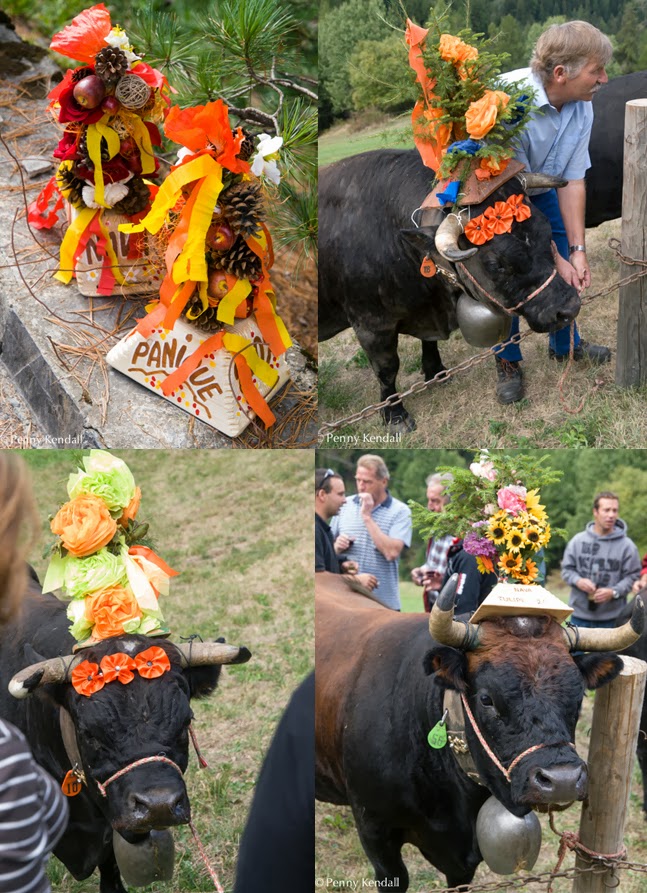
Tying on the flower headdresses - not that easy
It's a great day of celebration with an early start on the mountain and a mass herding of the beasts down to the villages. Help is needed to try and keep them from stampeding - best left to the experts and to stay at the back with the slow ones...

A variety of flower headdresses
Once down headdresses of flowers are tied between the horns in true Valaisanne tradition. Then the parade can begin. Each cow led by it's proud owner through the village - there's clapping for best milker, cheese maker and then the bossiest one (the Queen) whose kept the herd in check. At the end of the village it's time to crack open a few bottles and sample some of the summer cheeses.
Parading through Ayer

Sunday, 1 September 2013

Bountiful balconies

'Geraniums' in Grimentz
Window boxes cascading with flowers is an expected summer site in alpine villages. Over in Austria they even give you a tax rebate to encourage you to plant-up your balconies. Here in the Val d'Anniviers the local commune plants tens of thousands of flowers every year - they hang in baskets along the side of the road, in niches and fill hollowed out logs next to fountains. Neighbours vie with each other as to who has the best display - some get creative with their planting - mixing blue and white lobelia, with yellow sunflowers, marigolds and nasturtiums.
Flowers fill every available vessel - including an old boot
Top choice of flower are the red varieties of pelargonium - easy to grow and lovers of sun they also tolerate dry conditions (ideal for those who forget to water their window boxes). However, it's quite tender and come the first frost the whole lot will be reduced to a brown sludge. Native to South Africa - this plant was first discovered and brought to Europe by English gardener and plant collector, John Tradescant, in 1633. Originally the pelargonium was classed as part of the geranium family, but as the numbers and varieties grew the two got reclassified into separate groups. Today there are over 200 species of pelargoniums and over 420 species of the hardy geraniums. Pelargoniums are not just pretty they are also valued for their oil and are used in perfume, medicine and aromatherapy.
Pelargoniums - top choice around here for window boxes

Wednesday, 14 August 2013

Water damage

Trees and islands have been washed away and a new river route formed
Early last week we had two days of heavy rain which caused the Navizence River to break its banks and carve out a new route for itself - something locals have not seen before. The force of the water was so great that bridges and islands were swept away, boulders the size of small houses moved, trees ripped out and banks eroded back. At its height the river flooded nearly the whole width of Le Pla.
Bridges have been swept away or left miles from the water
What's been left is (I think) a more beautiful and more natural looking river which meanders a broader route - new islands have been made and the banks re-sculpted.
Walking along what was the jeep track- now stripped down to the moraine a few feet down
Work has already begun to reinstate bridges, and jeep tracks - but it will be interesting to see what they can do to the route used in winter by cross country skiers. Currently the once wide jeep track is down to the width of a footpath and one of the crossing bridges now spans a boulder field - the river now takes a route several hundred meters away leaving you unable to cross from east to west bank.

Looking down Le Pla and the new look Navizence River